Identify the container first
Many decorative containers are closed cachepots without drainage holes. They can hold an inner nursery pot that drains, provided you can remove it and inspect the bottom. Planting directly into a closed vessel leaves excess water with nowhere to go, making it a less straightforward starting point for ordinary houseplants.
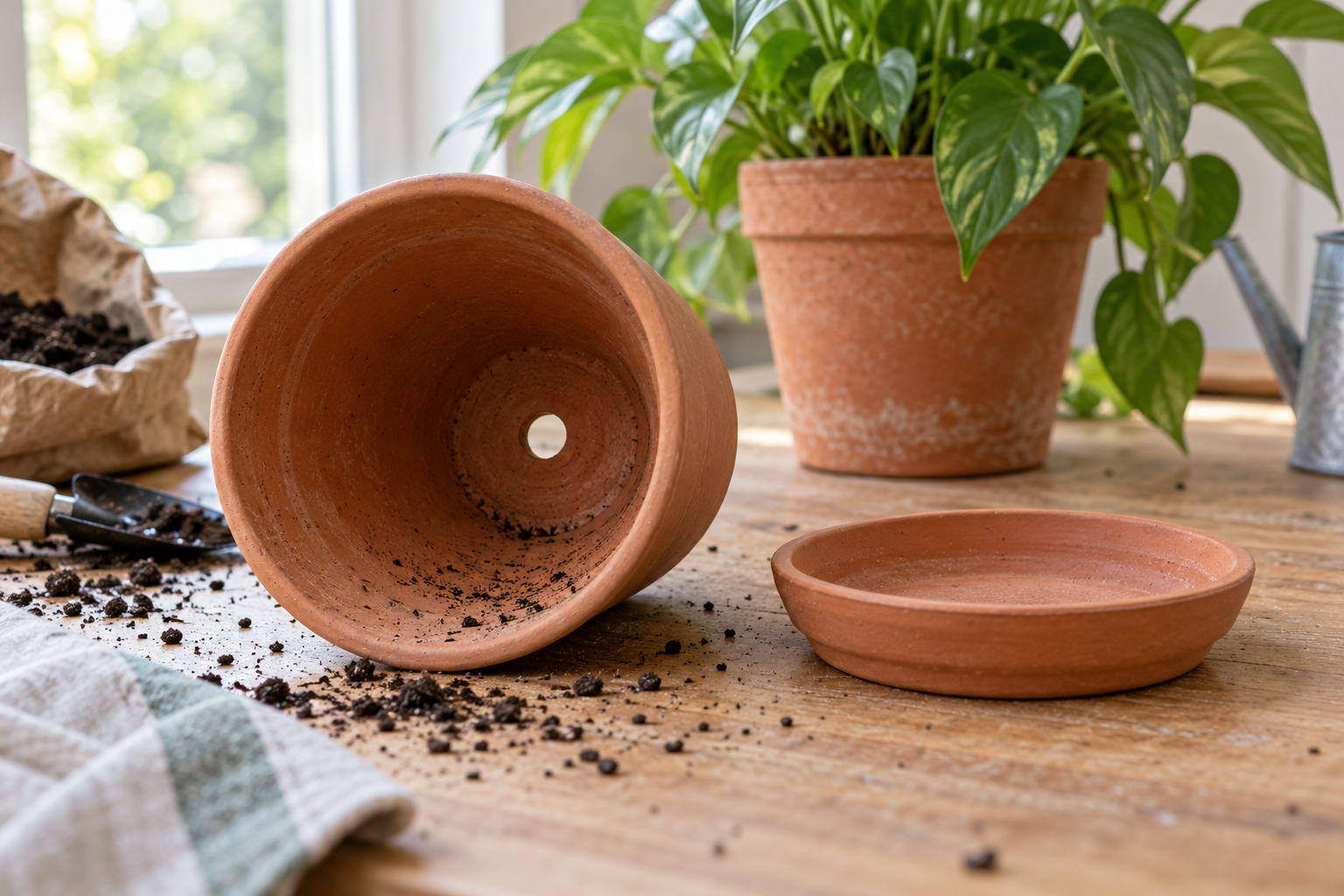
Look underneath before buying and check that the openings are clear. A product being called a planter does not settle the question. If you intend to alter a container, confirm that its material and construction are suitable. A fragile decorative piece is not worth cracking through an improvised drilling attempt.
Give water somewhere to go
With a manageable pot, you can take the plant to a suitable sink, water according to its needs and let it drain before returning it to its outer container. Keep loose compost out of the drain. For larger plants, arrange collection that can be emptied without dangerously tilting a heavy pot.
A drainage hole does not solve every watering problem. If the pot remains in accumulated water, its roots are still exposed to the excess. The opening also cannot compensate for unsuitable growing medium or watering without checking what the plant needs first.
Choose a saucer you can inspect
A saucer should collect drainage without being so concealed that you never notice its contents. Empty surplus water once drainage has finished, unless the specific plant and growing system require something different. Conventional pots and designed self-watering systems do not operate in the same way.
Check that the saucer is watertight and that its underside suits the furniture or floor. Protection underneath may prevent some scratches, but it does not remove the need to check for moisture. Lift the arrangement periodically to look for concealed damp marks.
Keep the outlet clear
During repotting, inspect the holes for roots or compacted debris that might obstruct them. Outdoors, fallen leaves and dirt can also interfere with water escaping. A deep layer of stones is not a substitute for a genuine drainage outlet.